Spin-Resolved Scanning Tunnel Spectroscopy of Atom-By-Atom Built Nanostructures
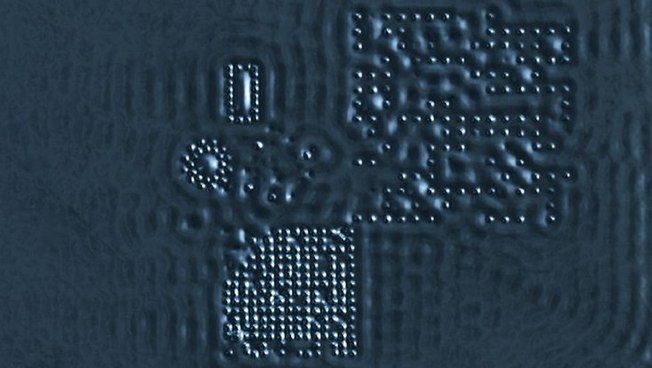
We are working on the emulation of complex solid-state quantum systems by building atomic-spin lattices on substrates hosting different itinerant electron systems (normal metals, semiconductors, topological insulators, superconductors, van der Waals materials). The spin-lattices are assembled, one atom at a time, with the tip of a scanning tunnel microscope as a tool. The same instrument is used to measure the locally and spin-resolved elecronic structure of the assembled quantum systems at low temperatures and with high energy resolution.
Quantum emulation emerged as a new paradigm for the forecast of real solid state quantum systems. Instead of using numerical simulation models, the idea is to emulate a complex solid state material by the experimental study of another more easily tailorable quantum system, which is tuned to have similar properties, e.g., spin sizes, mutual magnetic couplings, and lattice structure as the material we would like to understand in the first place. The ability of tuning the parameters of such tailorable quantum systems and to locally measure the changes in its electron phases under such variations might enable to predict how complex material systems have to be changed in order to show desired properties. Due to the geometry of the surface, such artificial atomic-spin arrays are inherently suited for the emulation of 1D and 2D problems. Since, here, electron and spin correlations are increasingly pronounced, most interesting and unexpected physics is believed to emerge in such low-dimensional cases.
 Photo: UHH/Lucas Schneider
Our main research interest for the past ~10 years has been towards the emulation of 1D spin-triplet superconductors by atomic-spin chains assembled on s-wave superconductors combining different atomic species and substrates [1]. If a 1D spin-triplet superconductor has a special, so called topologically non-trivial, band structure, it is theoretically predicted to host Majorana bound states at the chain's ends, which we try to detect with the scanning tunnel microscope.