
Physics and Chemistry of Nanomaterials (M.Sc.) (ex Nanoscience)
The PCN Master's programme -taught in English- starts in the wintersemester 2026/27 and will replace the Nanoscience programme. The curriculum and the requirements remain the same as in Nanoscience (M.Sc.).
Curriculum
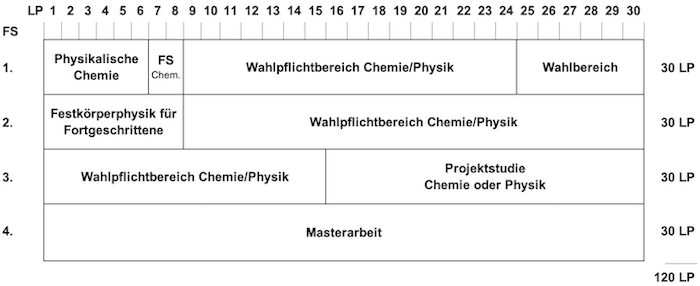
The Master’s programme consists of four stages:
- Introductory phase (16 ECTS credits)
• Compulsory modules in chemistry and physics, each worth 8 ECTS credits - Specialisation phase (53 ECTS credits)
• Chemistry and physics, each worth at least 21 ECTS credits
• The remaining 11 credits can be covered by the remaining range of compulsory elective modules in chemistry and/or physics and/or from the ‘further specialisation modules’ section. - Research phase (45 ECTS)
• Project study (15 ECTS)
• Final module: Master’s thesis (30 ECTS) - Elective module (6 ECTS)
Program structure
The programme consists of three phases: a foundational phase, a specialisation phase and a research phase.
During the foundational phase, students build on the fundamentals of nanoscience acquired in their Bachelor's programme by taking compulsory modules in solid-state physics, nanostructure physics, physical chemistry and materials chemistry.
During the specialisation phase, students acquire the advanced nanoscience and material knowledge necessary for independent, productive work. This phase comprises compulsory elective modules based on the research areas and specialisms of the Chemistry and Physics departments.
The research phase consists of a project study in chemistry or physics and a Master's thesis. The project study is intended to lead to the Master's thesis and is coordinated with the thesis supervisor.
Examination regulations
Physics and Chemistry of Nanomaterials (M.Sc.)
- Fachspezifische Bestimmungen (incl. module catalogue) (german)
vorläufige, nicht-amtliche Fassung!