
WISPFI
WISPFI: Weakly Interacting Sub-eV Particles searches on a Fiber Interferometer
WISPFI is a table-top, model-independent axion search utilizing a Mach–Zehnder interferometer equipped with a hollow-core photonic crystal fiber (HC-PCF) in the sensing arm. In the full setup, the interferometer operates at a dark fringe with amplitude locking, while an optical switch alternates between two narrow-line lasers at 1535 nm and 1570 nm at 100 kHz. Because only one wavelength resonates with the HC-PCF—satisfying the condition neff < 1 for a given axion mass—photon–axion conversion (observed as amplitude loss) takes place only during the corresponding half-cycle. This results in a synchronous amplitude modulation at 100 kHz, which is detected in the dedicated amplitude readout, allowing highly sensitive detection of ma = ω√(1 - neff2), surpassing the capabilities of standard dielectric fibers.


Figure 1: Top: Image taken with a Scanning Electron Microscope (SEM) of a HC−PCF with 8.5 μm core radius. Bottom: Finite Element Method (FEM) simulation (COMSOL) showing the mode field distribution for a simplified HC-PCF model with an 8.5 μm core radius, a capillary-to-core radius ratio of 0.682, and a wavelength of 1.55 μm. The red-colored region in the hollow core represents the intensity distribution of the electric field, illustrating the propagating mode confined within the core
The prototype currently under commissioning at Universität Hamburg couples a 2 W, 1550 nm laser into a 1 m-long HC-PCF section embedded in a ∼ 2 T permanent-magnet array. In this prototype stage, the interferometer employs phase locking. A fully automated Python-based data acquisition system continuously monitors and logs polarization, laser wavelength, beam profile, temperature, and humidity, enabling stable long-term unattended operation. The prototype is projected to reach gaγγ ≳ 1.3×10⁻⁹ GeV−1 at ma ≈ 49 meV over 30 days, making WISPFI the first tabletop ALP search capable of probing this unexplored mass region in a dark matter–independent manner.
WISPFI is designed to be scalable. Pressure tuning of the gas inside the HC-PCF will allow systematic mass scanning between approximately 10–150 meV, while an integrated Fabry–Pérot cavity in the sensing arm will enhance the effective optical power and interaction length. This creates a pathway from the tabletop prototype to a full-scale WISPFI implementation capable of probing the QCD axion band and reaching DFSZ sensitivity in an as-yet unexplored mass range.
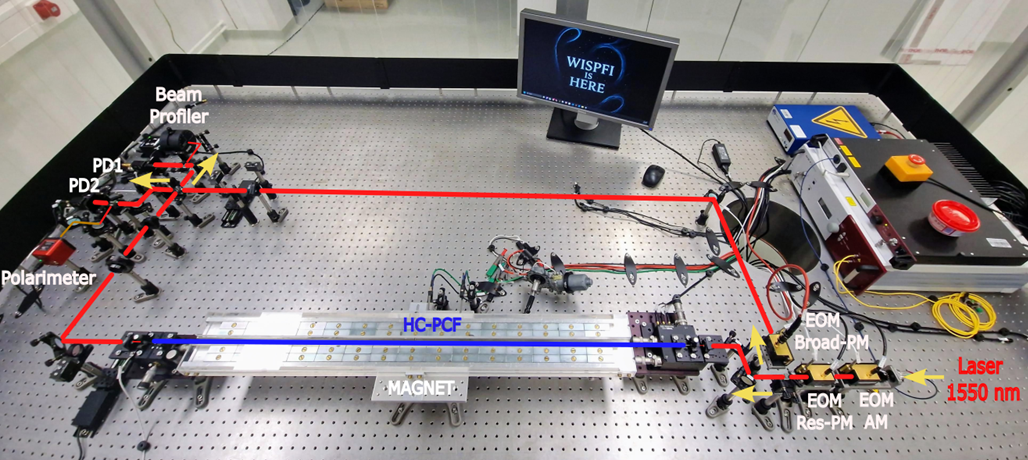
Figure 2: Photograph of the WISPFI prototype under commissioning at the University of Hamburg. Free-space optical paths are indicated in red, while the HC-PCF in the sensing arm is shown in blue inside the magnet array.
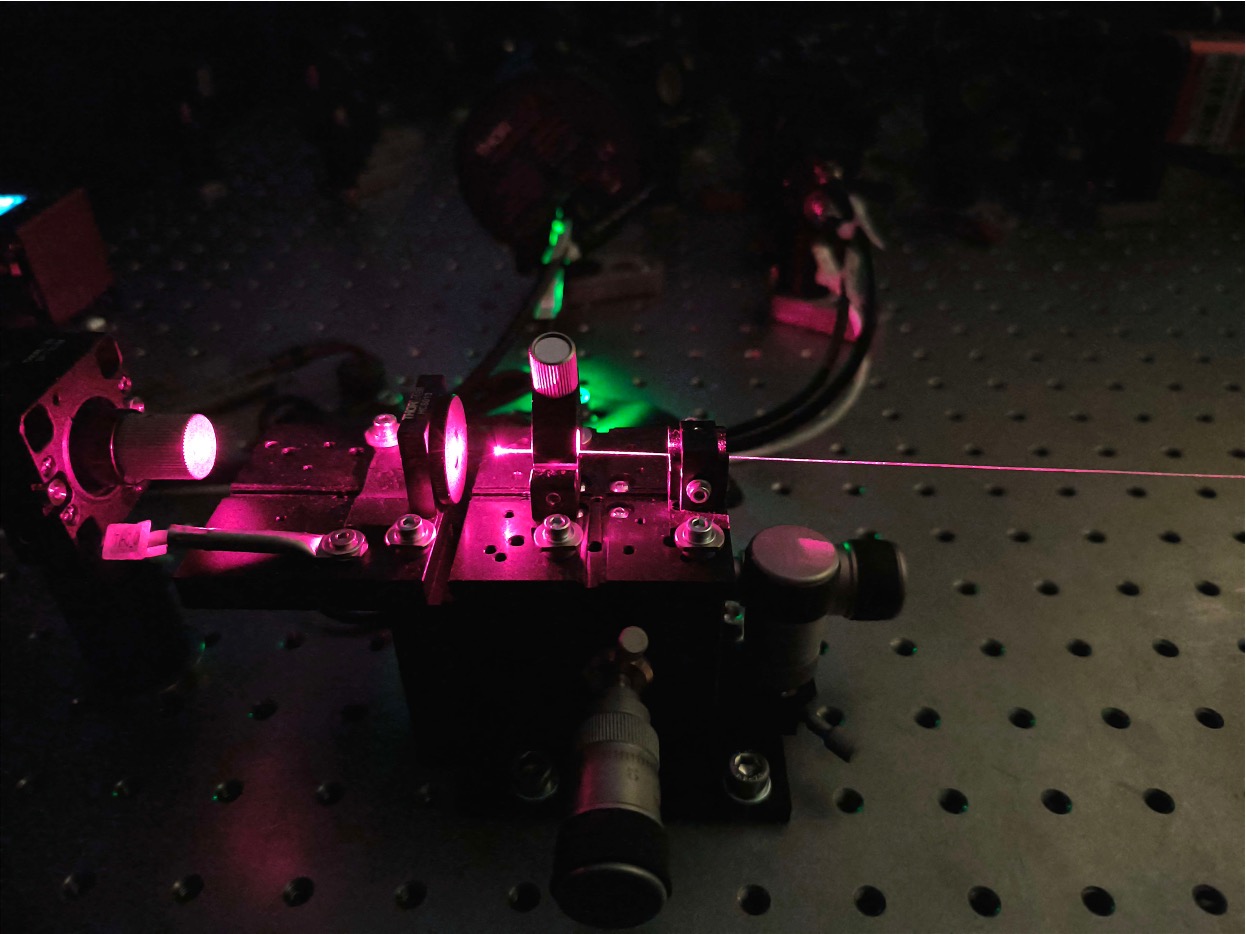
Figure 3: As part of the free-space to fiber coupling for the WISPFI experiment, a red light source is shining through a hollow-core photonic crystal fiber (HC-PCF).
Selected Presentations and Publications
- J.M. Batllori et al., “Searching for weakly interacting sub-eV particles with a fiber interferometer in a strong magnetic field”, Phys. Rev. D 109, 123001 (2024). doi:10.1103/PhysRevD.109.123001
- J.M. Batllori et al., “WISPFI Experiment: Prototype Development”, in Proc. 19th Patras Workshop on Axions, WIMPs and WISPs (2025). arXiv:2510.01221
- M. Maroudas, “WISPFI: Towards a Magnet Assisted Fiber Interferometer Search for Axionlike Particles”, 19th Patras Workshop on Axions, WIMPs and WISPs, Granada, 2025. https://agenda.infn.it/event/45898/contributions/271430/<;/a>
Interested in writing a thesis (BSc/MSc) on this topic? Take a look at our proposals.