
WINTER
WINTER: Weak interacting slim particle INTERferometer
WINTER is a free-space Mach-Zehnder-type interferometer incorporating an external magnetic field and vacuum in one of the arms, where photon–axion mixing occurs via the Primakoff effect and is detected as a small amplitude reduction at the dark port. The expected axion-induced signal is modulated at low frequency (∼ 20 Hz) through controlled polarization changes, separating a potential axion-induced amplitude change from slow drifts and other instrumental noise. The experiment is designed to integrate a Fabry-Pérot cavity with a finesse of 105 operated in vacuum, significantly enhancing both the effective interaction length and circulating optical power, while amplitude modulation is used for interferometric locking.
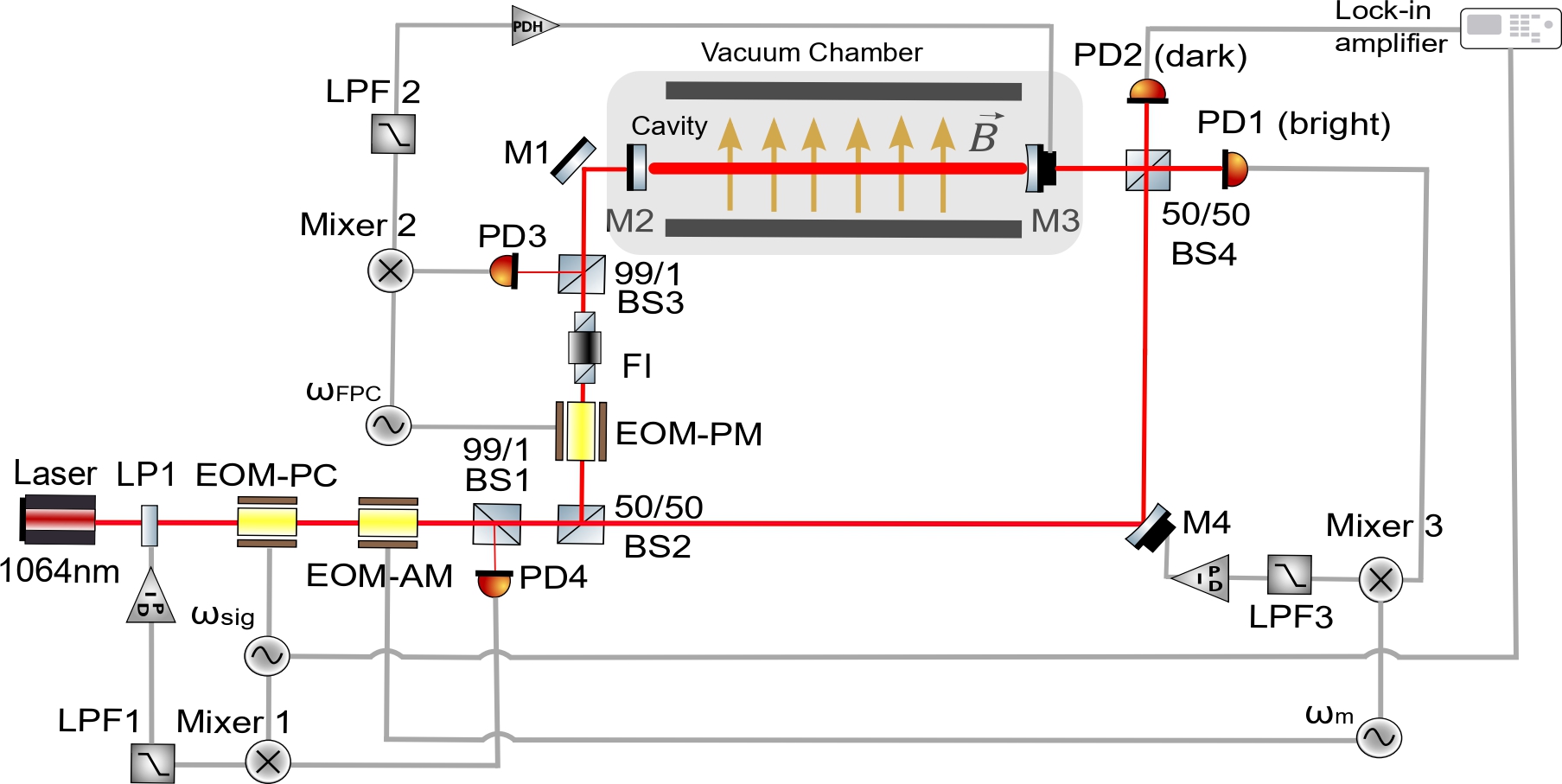
Figure 3: Schematic view of the experimental setup of WINTER using a free-space MZI for broadband detection. In red, the laser beam in free space is shown. The sensitive arm of the interferometer is placed inside a vacuum chamber with a FPC of 10 m length integrated in a dipole magnet with 9 T of the same length. The acronyms correspond to: electro-optical modulator (EOM) with amplitude (EOM-AM), phase (EOM-PM), and polarization (EOM-PC) modulation, Faraday isolator (FI), linear polarizer (LP), signal generator (SG), beam-splitter (BS), photo-detector (PD), mirror (M), and low-pass filter (LPF).
A prototype implementation is under commissioning at the University of Hamburg, using a 1 meter-long permanent magnet array producing approximately 1.2 Tesla, together with a 1550 nm, 2 W laser and a vacuum-enclosed Fabry–Pérot cavity (F~3×10⁴). Under these conditions, WINTER will probe axion–photon couplings down to gaγγ ≳ 7.1×10⁻¹¹ GeV−1 up to ALP masses of around ∼ 996 µeV over approximately 30 days of data collection.
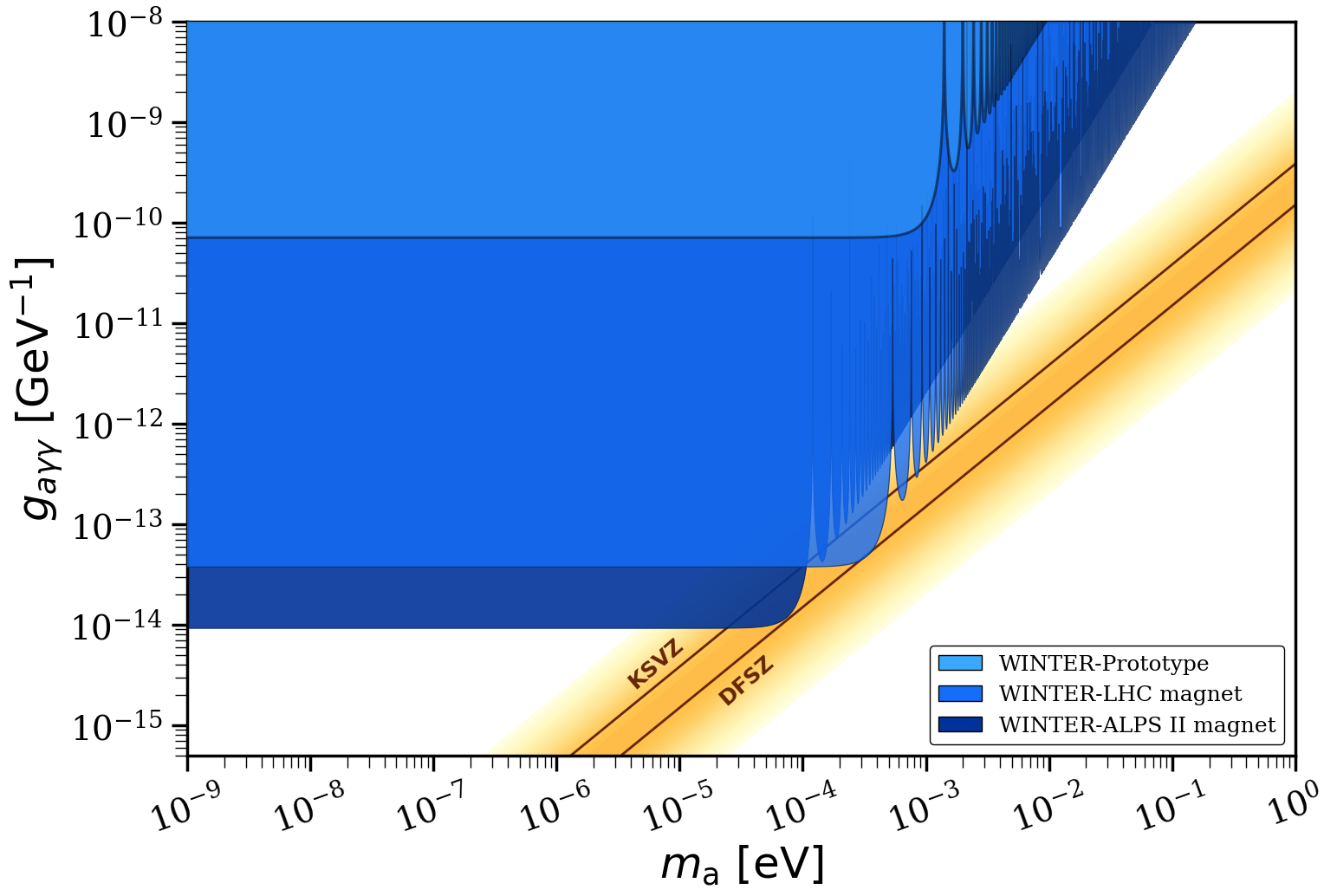
Figure 4: Projected sensitivity for WINTER experiment using an LHC and ALPS-II magnet configurations, as well as a prototype currently under construction in University of Hamburg.
The concept is inherently scalable, with sensitivity mainly limited by available magnet length, optical power, and achievable cavity finesse. Extending the sensing arm to LHC-type dipole magnets (∼ 10 m length, ∼ 9 T field) combined with a high-finesse (F~105) Fabry–Pérot cavity, offers a pathway to reach sensitivities of gaγγ ∼ 3.7×10⁻¹⁴ GeV−1 within the same architecture and analysis framework.

Figure 5: Assembly of the WINTER experimental setup, incorporating a vacuum chamber, is underway
Selected Presentations and Publications
- J.M. Batllori et al., “Broadband interferometry-based searches for photon–axion conversion in vacuum”, arXiv:2509.16725 (2025).
Interested in writing a thesis (BSc/MSc) on this topic? Take a look at our proposals.