
WispCAT
WispCAT: Weak interacting slim particle searches with a superconducting CAviTy
WISPCAT targets axion dark matter around ∼ 9 GHz (∼ 36 μeV) by coupling an underdamped graphene Josephson junction (GJJ) bolometer to a superconducting high-Q microwave cavity. Graphene offers extremely small heat capacity, high electron mobility, and weak electron–phonon coupling, enabling strong microwave photon absorption. In the GJJ, graphene is placed between two superconducting electrodes forming a hysteretic junction, where the switching current Is (SC → NC) is sensitive to the electron temperature and thus to absorbed microwave power, allowing ultra-low-noise voltage detection. Demonstrated performance reaches 〈 NEP 〉 300 mK = (7 ± 2) × 10−19 W/√Hz (single 32 GHz photon energy resolution) with an extrapolated 〈 NEP 〉 20 mK ≈ 10−21 W/√Hz.
In WISPCAT, the GJJ is coupled with a λ/2 resonator and will be connected to the superconducting microwave cavity, following the readout topology established for graphene JJ bolometers. A first calibration of this on-chip resonator was recently performed at Universität Hamburg by quasi-reflectometry with gate-voltage sweeps at 120 mK, yielding a resonance at f0 ≈ 8.73 GHz.

Figure 9: Prototype graphene Josephson-junction (GJJ) microwave bolometer assembly. The device consists of a graphene weak link between two superconducting electrodes forming an underdamped JJ, whose switching current is used as the detection observable. The MW input port couples the incident microwave power to the on-chip λ/2 resonator, which heats the electronic system in graphene, while gate biasing is used to tune the operating point. The physical scale is indicated by the reference coin.
The WISPCAT effort is carried out in collaboration with the DMAG (Dark Matter Axion Group) in South Korea, who are currently developing the final microwave cavity. The design is based on an HTS polygonal geometry using HTS tape and is expected to reach Q ≈ 107 while operated under an external magnetic field of ∼ 8 T. The cavity will be coaxially coupled to the GJJ–bolometer chain described above. Using V=0.12 L, C=0.55, a system noise temperature of 1 K, SNR=5, and an integration time of one day, this configuration is projected to reach DFSZ-level sensitivity around ma ≈ 36 μeV. Final cavity geometry, coupling, and integrated readout optimization are ongoing.
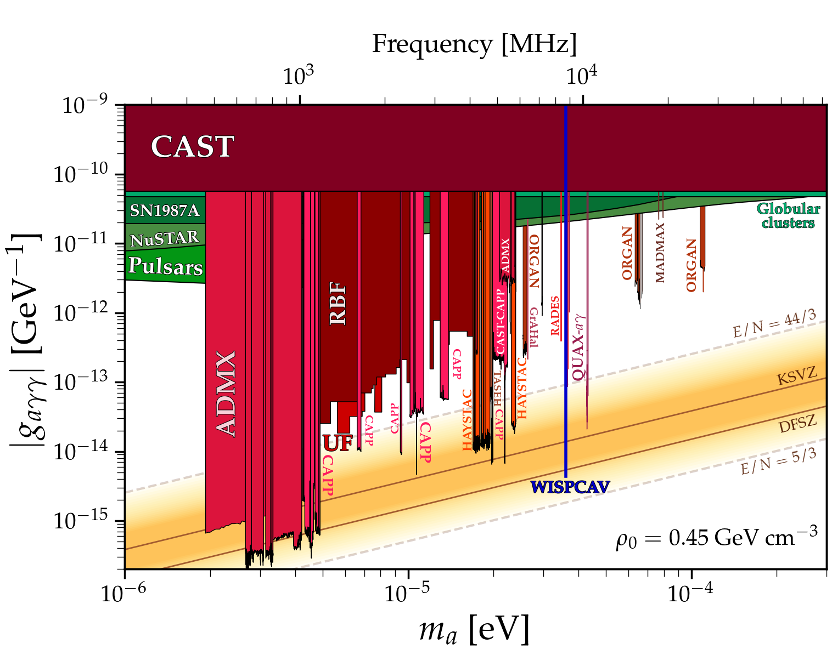
Figure 10: Projected WISPCAT sensitivity (in blue) to the axion-photon coupling gaγγ around ma ≈ 36 μeV based on the GJJ bolometer and superconducting cavity configuration. The projection shown assumes V = 0.12 L, C = 0.55, Tsys = 1 K, SNR = 5, and one day of integration time. The DFSZ benchmark is shown for comparison. Plot adapted from C. O’Hare, AxionLimits, Zenodo (2020), doi: 10.5281/zenodo.3932430.
Selected Presentations and Publications
- G. Lee et al., “Graphene-based Josephson junction microwave bolometer”, Nature 586, 42–46 (2020). doi:10.1038/s41586-020-2752-4
- D. Ahn et al., “Biaxially Textured YBa2Cu3O7-x Microwave Cavity in a High Magnetic Field for a Dark-Matter Axion Search”, Phys. Rev. Applied 17, L061005 (2022). doi:10.1103/PhysRevApplied.17.L061005
- M. Maroudas, “Axion, ALP, and HFGW Searches Across Complementary Experimental Frontiers”, 20th Patras Workshop on Axions, WIMPs and WISPs, Lisbon, 24–26 Sept 2025. https://agenda.infn.it/event/46273/contributions/269303/<;/a>
Interested in writing a thesis (BSc/MSc) on this topic? Take a look at our proposals.