
WISPDMX
WISPDMX: WISP Dark Matter eXperiment
WISPDMX is a cavity haloscope targeting hidden-photon (HP) dark matter in the sub-μeV regime, originally conceived to cover the 0.8–2 μeV band with a large-volume, high-Q copper resonator. The experiment repurposes a 208 MHz HERA RF cavity and exploits resonant enhancement of photon production via kinetic mixing, scanning multiple electromagnetic modes (TM010, TM020, TE111) across a broad frequency span. In parallel to the narrow resonant operation, the readout chain enables broadband acquisition at 500 MHz with high spectral resolution, allowing simultaneous coverage of several modes.

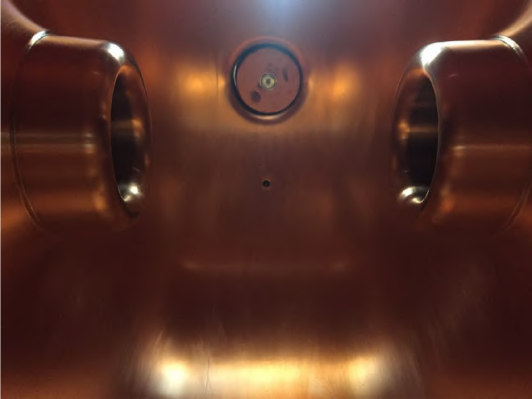
Figure 13: Top: A photo of the WISPDMX experiment with the 208 MHz resonant cavity with two modified plungers. Bottom: The photo of the inner surface inside the cavity. The surface is polished to maintain the high electromagnetic reflection, one can see the two nose cones preserved for the beam line
The apparatus combines standard RF cavity metrology (reflection/transmission S–parameters, loaded Q, coupling) with a low-noise heterodyne readout chain feeding both a spectrum analyzer and a high-resolution digitizer. The averaged spectrum of the first physics run (61 hours) reached a minimum detectable power of approximately 5×10⁻²² W. From these spectra, WISPDMX set limits on hidden-photon kinetic mixing at the level of χ ≈ 10−13 on resonance and χ ≈ 10−12 in the broadband region between 0.2–2.07 μeV, with sensitivity steadily degrading at masses below 0.2 μeV. The first science data from WISPDMX have established world-leading cavity-based limits for hidden photons in this region.
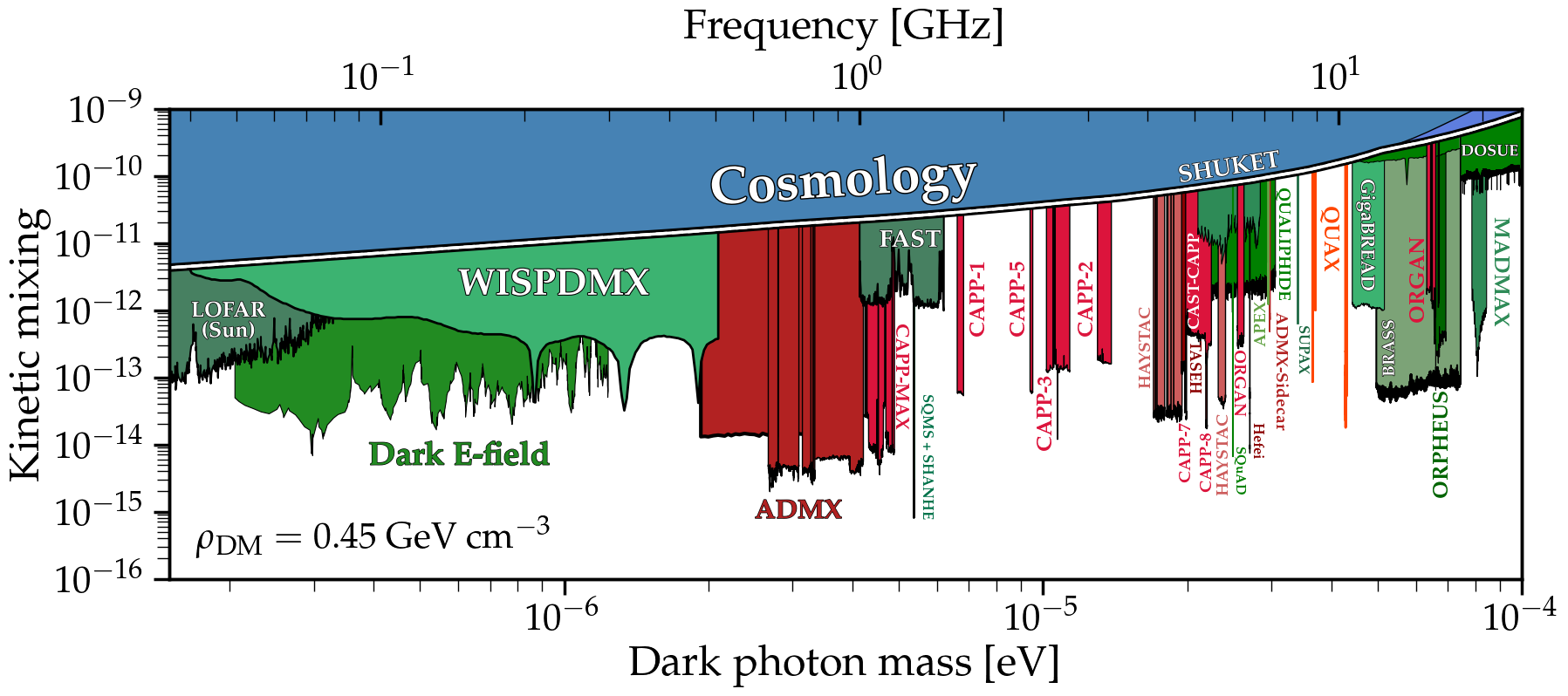
Figure 14: Exclusion limits on hidden photon dark matter in terms of kinetic mixing versus mass. The WISPDMX excluded region is shown in green, covering the 0.8−2 μeV range, along with a comparison to other haloscope and astrophysical constraints across the full dark photon mass spectrum
Coupling the WISPDMX cavity to a strong magnetic field (e.g., inside a high-field warm-bore magnet such as CERN’s Morpurgo magnet) would also enable axion/ALP searches using the existing infrastructure. Currently, WISPDMX is also employed as an advanced laboratory course experiment at the University of Hamburg, providing hands-on training in precision RF cavity instrumentation, calibration, and broadband spectral analysis in the context of dark matter detection.
Selected Presentations and Publications
- Nguyen, Le Hoang et al., WISPDMX: A haloscope for WISP Dark Matter between 0.8–2 μeV, 11th Patras Workshop on Axions WIMPs and WISPs. DOI: 10.3204/DESY-PROC-2015-02/nguyen_lehoang
- Nguyen, Le Hoang et al., First results from the WISPDMX radio frequency cavity searches for hidden photon dark matter, JCAP 10 (2019) 014. DOI: 10.1088/1475-7516/2019/10/014
Interested in writing a thesis (BSc/MSc) on this topic? Take a look at our proposals.