Physics / Physik (M.Sc.)
The M.Sc. Physics program builds on a Bachelor’s degree in physics or a closely related field. Through specialized coursework and independent research, it deepens your understanding of fundamental principles and advanced methods, preparing you for careers in science, technology, and industry, as well as for doctoral studies.
Inhalt
M.Sc. Physics in Hamburg
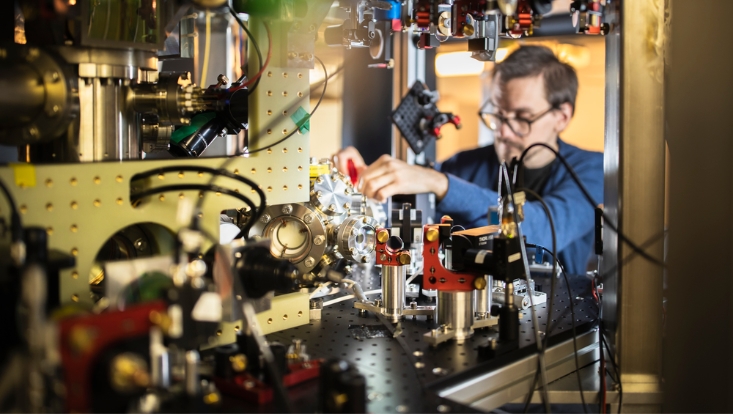
Foto: UHH/Esfandiari
Study Physics at the Research Frontier
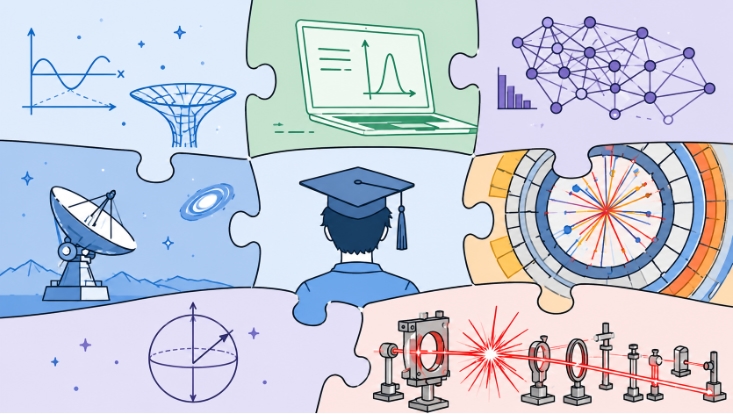
Study in one of Germany’s largest physics departments. With two Clusters of Excellence (Quantum Universe and CUI: Advanced Imaging of Matter) the department is among Germany’s leading centers for modern physics research. You work at the research frontier, from fundamental particles to ultrafast imaging and quantum technology.

Foto: Martin Eckstein (AI)
Strong Research Partnerships
Benefit from close links to the Max Planck Society, DESY, and the European XFEL, all located on a unique research campus. Long-standing cooperations between UHH and these institutions, with joint initiatives like the Wolfgang Pauli Centre for Theoretical Physics, give you direct access to world-leading facilities and international teams.

Foto: Martin Eckstein (AI)
Build your individual study path
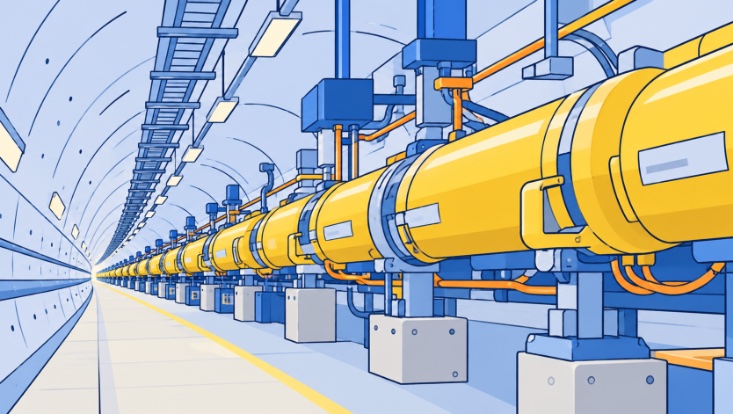
A broad spectrum of specialization areas reflects a broad range of modern physics, from fundamental theory to applied and interdisciplinary fields. With a large selection of courses and a flexible program structure, you can tailor your studies to your interests and career goals, whether you aim for a PhD or a career in industry.

Foto: Martin Eckstein (AI)
A globally connected city
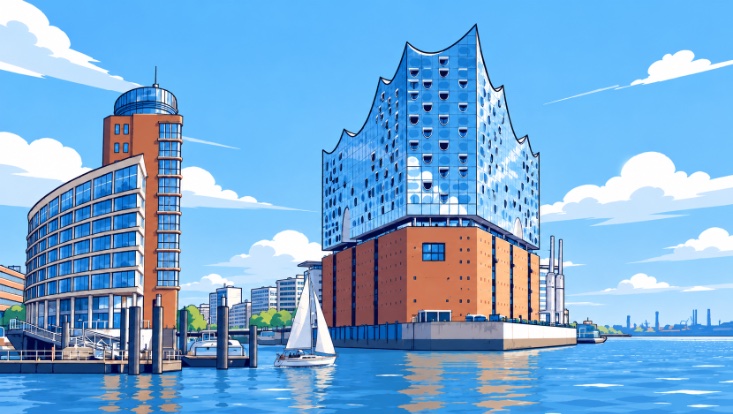
Study in a major European harbor city, where a vibrant cultural life meets a dynamic scientific and industrial landscape. From world-leading research centers to aerospace and technology companies, Hamburg provides many career opportunities --while the Elbe beach, cafés, and music venues leave plenty to enjoy beyond the lecture hall.
Specialization Areas
General Information
Study Plan (enrollment starting WiSe26/27)
The MSc Physics program consists of a one-year coursework phase (specialization) and a one-year research phase:
Coursework Phase (1st–2nd Semester)
48 credit points (ECTS) must be taken in advanced physics modules across our seven specialization areas. There is a high degree of flexibility, with only few guiding requirements: At least one area must contribute ≥16 ECTS, none more than 36 ECTS, and at least 8 ECTS each must be taken in Experimental and Theoretical Physics. (Example study plans can be found on the pages of the specialization areas).
In addition, 12 ECTS in a Free Elective Area can be chosen from courses across the University of Hamburg.
Research Phase (3rd–4th Semester)
The second year focuses on research. You join a research group and work on a current topic, possibly in collaboration with external parner institutions such as DESY, the European XFEL, or the Max Plack Institute MPSD.
The research phase includes two introductory projects (15+15 ECTS, 3rd Semester ) and the Master’s Thesis (30 ECTS, 4th Semester). In most cases, these projects build consecutively on a coherent research topic, allowing you to develop deep expertise and contribute to ongoing research.
Module Catalogue (enrollment starting WiSe26/27)
The Module Catalogue 2026 (PDF) provides an overview of the modules offered in the MSc Physics / Physik program, including their content and frequency.
In addition to the regularly offered modules, the program includes specialized courses and seminars covering current research topics. You can explore courses offered in previous semesters in the STiNE Course Catalog.
In the English STiNE interface, navigate to: Course Catalogue → Semester → Faculty of Mathematics, Informatics and Natural Sciences → Department of Physics → For students of Physik (M.Sc.) / Physics (MSc).
Note: Prior to winter semester 2026/27, the program was organized into five instead of seven areas of specialization. Courses in earlier semesters are listed under the former structure.
Study Plan and Module Catalogue (enrollment until SoSe2026)
The course of study is divided into a graduate coursework phase and a research phase:
In the first two semesters acquired knowledge of the field is developed, and electives are chosen. In this year, skills in at least one research area, corresponding to the main research areas of the department, are expanded:
- Accelerator and elementary particle physics
- Solid state and nanostructure physics
- Laser physics and photonics
- Astronomy and astrophysics
- Biomedical physics
The one-year research phase follows in the third and fourth semesters. During which students in a research group complete the semi-year Master's thesis after the practice, and the preparation project.
- Curriculum (PDF)
- Requirements (PDF) (english)
- Amended version of the Subject specific regulations (FSB) and Module table (Annex A) for students starting in WS 21/22 (german)
- Subject specific provisions and module table from WiSe 19/20 (english)
- Module table - unofficial translation (english)
- Module catalogue 02/2023 (german)
- Module catalogue 02/2023 (english translation)
- Examinations regulations of the Faculty MIN for Master of Science (german and english)
Study regulations
Detailed legal examination regulations and subject specific amendments (Fachspezifische Bestimmungen, FSB) for all M.Sc Programs at the Department are found here on the pages of the Campus Center.
Note: This page is in German, but it provides all documents in English. Go down to Fachberecich Physik > Master and select your program. There may be different regulations depending on you starting semester.
For those who enjoy not only physics but also navigating German bureaucracy, these documents offer plenty of reading material.
Application and Deadlines
Universität Hamburg offers two closely related Master's programs in Physics. They are equivalent in content, and students attend the same courses in practice, which are generally taught in English. The main differences concern the application periods and language requirements.
-
M.Sc. Physics (international program)
Start: winter semester only
Application period: 15 February – 31 March
Language: English
The application period is scheduled to accommodate international applicants. -
M.Sc. Physik
Start: winter or summer semester
Application periods: 1 May – 15 June (winter semester) and 1 December – 15 January (summer semester)
Language: German; courses are predominantly taught in English.
Proof of sufficient German language proficiency is required.
Application information
Detailed and authoritative information on application and admission is provided by the Universität Hamburg Campus Center:
Further Links
For incoming students:
International students and students coming to Universität Hamburg from another university are encouraged to consult the University's central information pages and the Faculty of Mathematics, Informatics and Natural Sciences (MIN) for guidance on studying and living in Hamburg, practical preparations, and available support services.
- Information for international degree students
- MIN Faculty guide for international students – faculty-specific information and guidance
- Before starting your studies – practical information on preparing for your stay in Hamburg
- Support and advice during your studies
- Campus life at Universität Hamburg
Study organization and courses
- STiNE Course Catalog – the public course catalog of Universität Hamburg, including courses from the current and previous semesters
- Academic Office (Studienbüro) – information and contacts for study organization, examinations, and academic advising