Experimental Physics
Institute of
Experimental Physics
Experimental Physics
Photo: UHH/Denstorf
13 February 2025
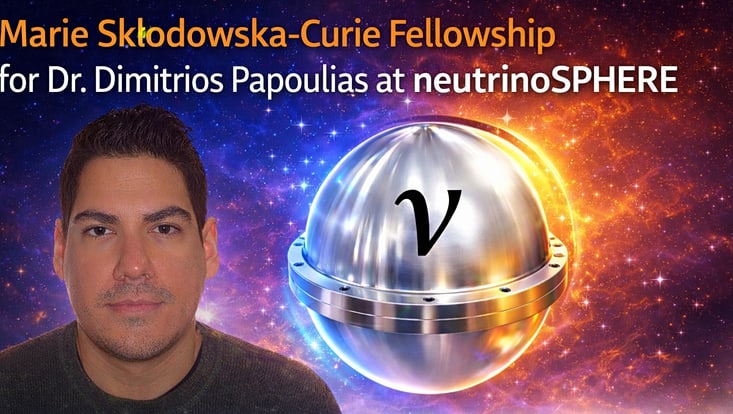
Photo: UHH
Dr Dimitrios Papoulias, a particle physics phenomenologist with expertise in astroparticle physics, has been awarded a Marie Skłodowska-Curie Postdoctoral Fellowship to undertake the neutrinoSPHERE project within the AG Nikolopoulos. Dr Papoulias will join the group following an EU-funded postdoctoral appointment at IFIC-Valencia. He brings a strong theoretical physics background at the intersection of nuclear and particle physics.
The neutrinoSPHERE project will advance the state of the art in modern astroparticle physics and open new directions in searches for new physics, aiming to address fundamental long-standing questions on the origin of neutrino masses and the existence of dark matter. It will exploit the ultra-low threshold capability of Spherical Proportional Counters, employed for dark matter searches by the NEWS-G Collaboration, to explore coherent elastic neutrino-nucleus scattering (CEvNS) beyond the Standard Model and dark matter-nucleus signals. To this end, neutrinoSPHERE will employ machine-learning techniques to develop new computational tools for fast and accurate signal reconstruction, incorporating systematic uncertainties.
The project has a duration of 24 months and includes research visits at IFT Madrid and NTUA Athens, where Dr Papoulias will collaborate with world-leading experts on machine-learning approaches and connections between astroparticle physics and cosmology.
The Marie Skłodowska-Curie Postdoctoral Fellowships are prestigious research grants funded by the European Union under the Horizon Europe programme. They support outstanding postdoctoral researchers worldwide through international mobility, interdisciplinary training, and collaboration. The fellowships fund innovative research across all scientific fields while promoting skills development, knowledge transfer, and long-term career progression. They are highly competitive, with the 2024 call recording a 16.6% success rate following 10,360 applications, the highest number submitted to an individual call at the time, and are widely recognised as a mark of research excellence in Europe and beyond.