
Experimental Physics
Institute of
Experimental Physics
Experimental Physics
Photo: UHH/Denstorf
7 September 2026
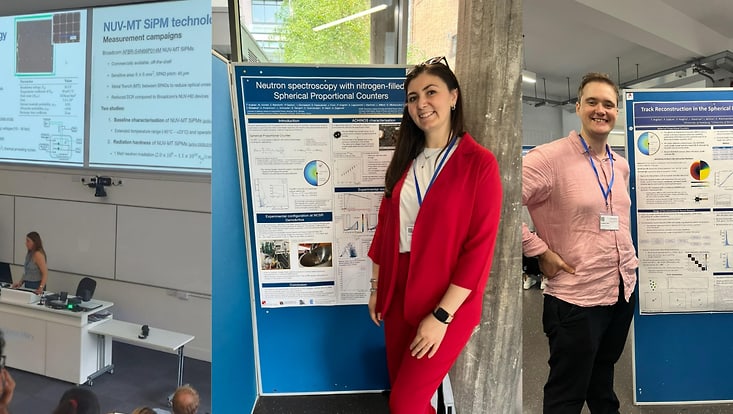
Photo: IO
From 1–4 September 2026, researchers from the particle and astroparticle physics communities gathered in London for PSD14, the 14th International Conference on Position Sensitive Detectors. The meeting brought together scientists to discuss recent developments and innovations in position-sensitive particle detectors.
Featuring 118 contributions, PSD14 offered a broad overview of recent advances in detector technology. Our group was represented by Dr Zoe Balmforth, Dr Isabella Oceano, and Dr Robert Ward, who presented work spanning three complementary areas: the characterisation and radiation hardness of silicon photomultipliers, neutron spectroscopy using spherical proportional counters, and machine-learning methods for particle-track reconstruction.
In her talk, Dr Balmforth presented a detailed characterisation of commercially available silicon photomultipliers (SiPMs) based on NUV-MT technology. She discussed key performance parameters measured at different temperatures and operating voltages. The work also investigated the SiPM radiation hardness following irradiation with a monoenergetic neutron beam.
Dr Oceano presented a poster on the use of a nitrogen-filled spherical proportional counter as a neutron spectrometer. The technique uses neutron-induced nuclear reactions in nitrogen to detect and characterise neutrons. The detector was tested for the first time using monoenergetic neutron beams at the TANDEM accelerator of the National Centre of Scientific Research “Demokritos” in Athens.
Dr Ward presented the latest developments in algorithms for particle-track reconstruction in spherical proportional counters in a poster. The work uses neural networks trained on simulated signals to reconstruct the tracks of cosmic muons traversing the detector. As a cosmic muon traverses the detector, it produces an extended ionisation trail. Differences in the timing of signals recorded by the individual anodes can therefore provide information about the particle’s direction, with the ultimate aim of reconstructing its track in three dimensions.
PSD14 enabled our researchers to present their work internationally, discuss recent results with colleagues, and follow new developments across the position-sensitive detector community. The conference was also a valuable occasion to build connections with scientists working on related experimental challenges.
