
Forschung
Projekte der Gruppe Prof. Dr. Markus Ilchen
Artificial intelligence for online characterization of ultrashort X-ray free-electron laser pulses
X-ray free-electron lasers (XFELs) as the world’s brightest light sources provide ultrashort X-ray pulses with a duration typically in the order of femtoseconds. Recently, they have approached and entered the attosecond regime, which holds new promises for single-molecule imaging and studying nonlinear and ultrafast phenomena such as localized electron dynamics. The technological evolution of XFELs toward well-controllable light sources for precise metrology of ultrafast processes has been, however, hampered by the diagnostic capabilities for characterizing X-ray pulses at the attosecond frontier. In this regard, the spectroscopic technique of photoelectron angular streaking has successfully proven how to non-destructively retrieve the exact time–energy structure of XFEL pulses on a single-shot basis. By using artificial intelligence techniques, in particular convolutional neural networks, we here show how this technique can be leveraged from its proof-of-principle stage toward routine diagnostics even at high-repetition-rate XFELs, thus enhancing and refining their scientific accessibility in all related disciplines.

Copyright: Dingel, K., Otto, T., Marder, L. et al. Artificial intelligence for online characterization of ultrashort X-ray free-electron laser pulses. Sci Rep 12, 17809 (2022). https://doi.org/10.1038/s41598-022-21646-x
Helicity-Controlled Photoelectron Angular Distributions from Oriented He⁺ in Intense Circularly Polarized Fields
In a joint experimental and theoretical study published in Physical Review A, we investigated how the helicity of circularly polarized light controls the angular emission patterns of electrons ejected from oriented He⁺ ions. Using the free-electron laser FERMI, we prepared He⁺ in the 3p (m=+1) state via XUV radiation and probed it with intense near-infrared pulses of co- or counter-rotating polarization. For co-rotating fields, the photoelectron angular distribution is governed by a single partial wave and remains independent of laser intensity. In contrast, the counter-rotating configuration reveals two interfering quantum pathways whose relative strength and phase shift rapidly with intensity, producing striking changes in the emission pattern. Our results demonstrate a new level of control over multiphoton angular distributions and extend the concept of a “complete experiment” into the multiphoton regime.
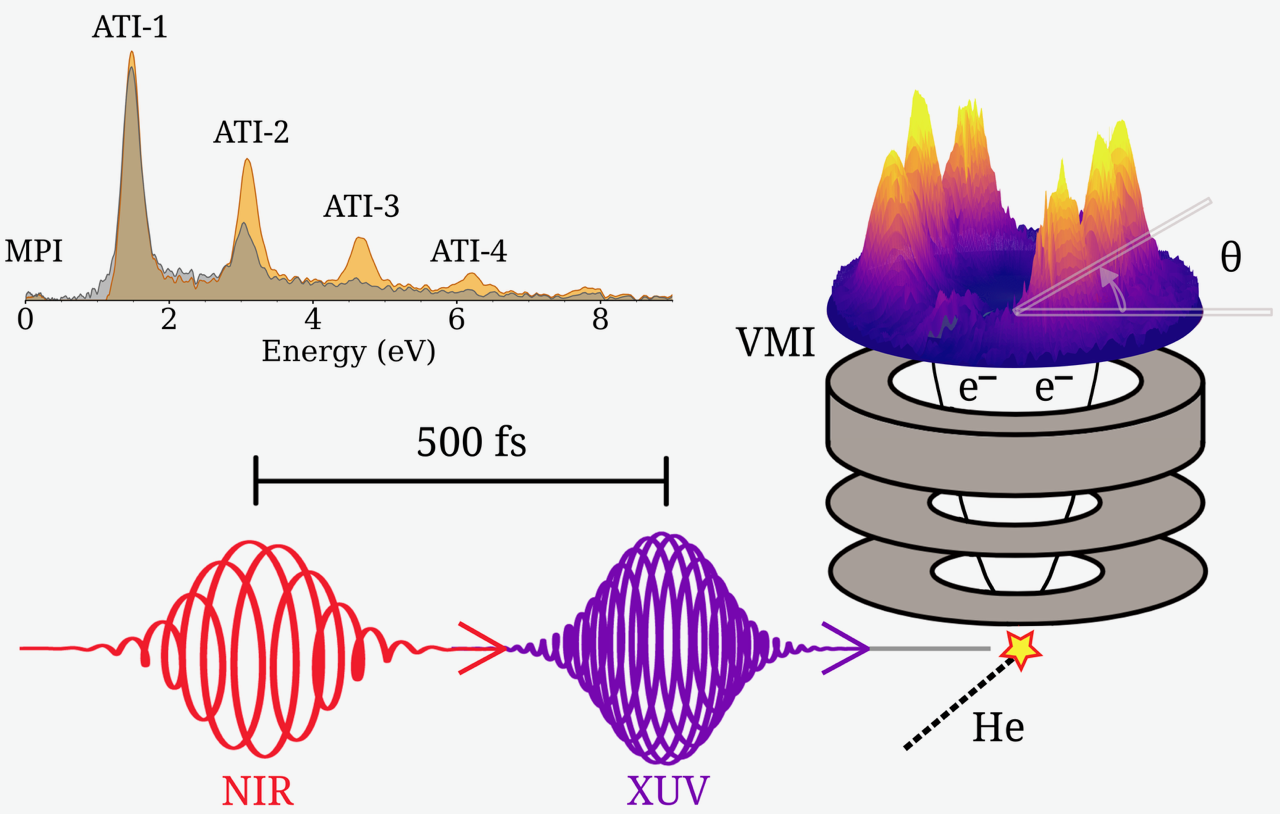
Copyright: Wieland et al. Phys. Rev. A 113, 043110 2026
Polarization Diagnostic at FLASH2
The commencement of polarization commissioning at Flash 2 has unveiled new opportunities within a diverse range of user experiments, providing complete control over the Free-Electron Laser (FEL) polarization. Initial diagnostics indicate the potential for VARIABLE polarization with the third harmonic following the installation of the Apple 111 afterburner undulator. The angular distribution of the photoelectrons provides information regarding the degree of polarization of the FEL pulse which ionizes them. Recent commissioning results shows a promising degree of circular polarization with the newly installed after burner undulator which was never measured before!
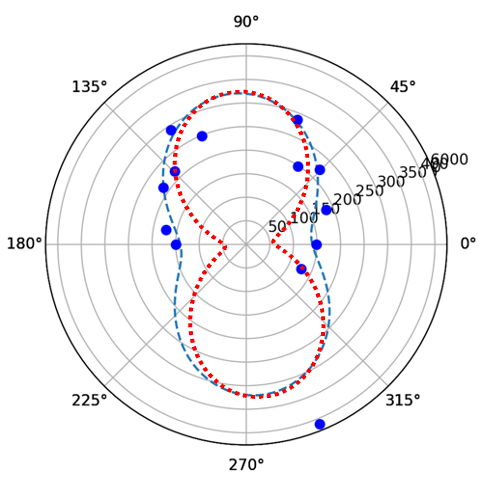
Copyright: Marotzke et al. Struct. Dyn. 12, 034301 (2025)
Attosecond Timing Tool based On angular Streaking for Experiments at the European XFEL
The project will focus on the development and construction of advanced spectroscopic instrumentation for the metrology of attosecond pulses in both laser-based laboratories and large-scale research facilities.

Copyright M. Ilchen
single-shot electron spectroscopy of transient matter
Single-shot electron spectroscopy can be used as a tool to investigate photoionization processes and the various subsequent relaxation dynamics, ie how the inner shell vacancies are redistributed and filled in atoms and molecules. This work investigates the generation of double-core holes (DCH) in neon atoms with very short lifetimes using the help of intense and tightly focused X-ray pulses at European XFEL at the attosecond frontier. An electron-time-of-flight (e-TOF) spectrometer equipped with a multi-electrostatic lens system followed by a microchannel plate(MCP) based detector is used to specifically collect DCH Auger electrons in single-shot spectroscopy. The wavelength tunability and high X-ray intensity at European XFEL together with this spectroscopic technique enable the study of highly transient systems. Examining the electronic structure of a core-excited system before relaxation can allow for gaining essential insights into ultrafast processes and nonlinear photoabsorption under extreme intensities thus opening a new field of spectroscopy of transient matter.
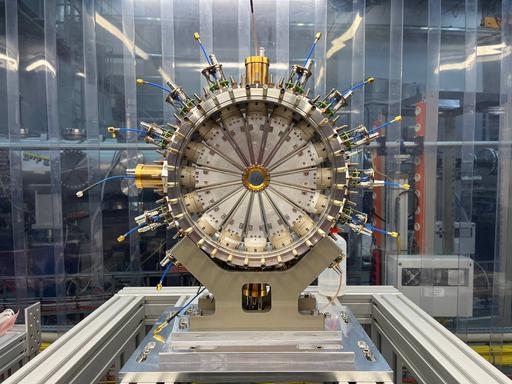
Copyright: M. Ilchen
Spectroscopy with Ultrashort and Ultraintense X-ray Pulses from Free-Electron Lasers
Free-electron lasers (FELs) are the world's most brilliant light sources with rapidly evolving technological capabilities in terms of ultrabright and ultrashort pulses over a large range of accessible photon energies. Their revolutionary and innovative developments have opened new fields of science regarding nonlinear light-matter interaction, the investigation of ultrafast processes from specific observer sites, and approaches to imaging matter with atomic resolution. One core aspect that our group is dedicated to is is the study of isolated and prototypical chiral systems in the gas phase with the possibility of addressing well-defined electronic transitions or particular atomic sites in molecules. Polarization-controlled short-wavelength FELs offer new avenues for investigations of nonlinear and ultrafast phenomena in chiral building blocks of life and for steering reactions and particle emission dynamics in otherwise inaccessible ways.

Copyright: M. Ilchen et al. Phys. Rev. Research 7, 011001 2025
Project Volt: Voltage Optimization for Broad-Bandwidth High-Resolution Electron Spectroscopy
The research project builds on the findings of a previous master's thesis, titled “Instrument for Broad Bandwidth, High-Resolution Electron Spectroscopy” and extends its scope to applications in the field of ultrafast processes in chiral matter. The initial phase of the project involves validating the results of the ongoing spectrometer optimization using FEniCS at the Beamline P04 (PETRA III). This phase includes the development and adaptation of a new spectrometer for use at Beamline P04. The project aims to compare simulation results with experimental data collected during planned beamtime at P04. Key performance parameters such as energy resolution and transmission are to be determined, along with exploring potential applications of the spectrometer. The planned procedure is based on a test already carried out by De Fanis and Prof. Ilchen

Copyright: M. Ilchen